

Integration is key: how interfaces make the difference
The digital energy industry demands interconnected systems. While new cloud applications and specialised software help companies make their processes more efficient, the real added value only emerges when all components work together seamlessly. The reality in many energy companies, however, often looks quite different: duplicate data maintenance, error-prone custom-built interfaces, and manually monitored file transfers consume valuable working time every day.
Anyone who wants to future-proof their IT landscape needs a clear integration strategy, that puts an end to the daily data chaos and clears the way for efficient digital processes. A modern approach addresses this through three central levers.
Data hubs instead of confusing point-to-point connections
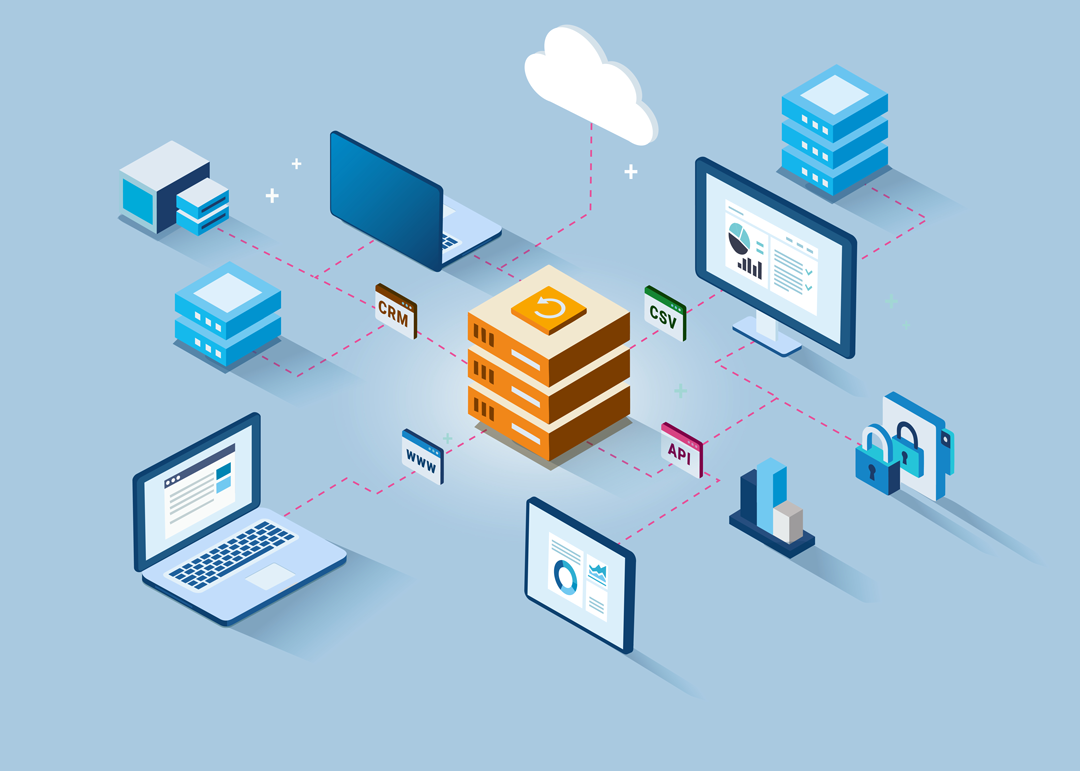
When data arrives incomplete or delayed, downstream business processes grind to a halt immediately. The problem usually lies in a tangled web of manually crafted individual interfaces. A centralised, automated integration layer provides the remedy. On our solution platform SOPTIM Elements, this role is fulfilled by ELEMENT:DataHub.
- Central harmonisation: Whether Excel, XML, CSV, REST, or SOAP — different data structures are translated in real time so that source and target systems can each remain in their own “native language.”
- Full automation with flexible logic: Data processing runs on a time-controlled or event-driven basis, via API or file deposit (S3/SFTP), without any manual intervention. Individual mapping functions sustainably improve data quality, while inconsistencies are detected early and resolved in a targeted manner.
- Transparency & control: Data flows can be monitored via an intuitive web interface using either a diagram or raw data view. Convenient filtering using defined tags keeps everything clear, and runs can easily be restarted with identical parameters at the click of a button.
- End-to-end processes: Processed data records offer direct jump-off points for immediately passing information on for further processing in other modules of the platform.
The secure bridge between on-premises and cloud
Many core processes in the energy industry still run on local servers, while new applications are increasingly hosted in the cloud. To enable a smooth transition, enormous volumes of data must be moved between these two worlds every day — individually scalable, high-performing, and stable.
- Structural integration: A modern transport solution integrates directly into your existing local directory structure and delivers data to the SaaS world in precisely the desired target format.
- No additional SFTP infrastructure: A secure, direct transfer path eliminates the need for separate, maintenance-intensive SFTP servers — reducing IT complexity, cutting costs, and minimising administrative overhead. In SOPTIM Elements, this connection is established by ELEMENT:FileTransfer.
- Tangible performance: Compared to conventional SFTP solutions, the optimised transfer channel offers significantly higher transmission speeds for large volumes of data in real time.
Comprehensive, well-documented APIs as the foundation for barrier-free interfaces
The most flexible connection loses its value if its implementation turns into a time-consuming exercise in detective work. That is why we invest considerable effort at SOPTIM Elements in extensive and transparent API documentation for our entire platform — because the quality and accessibility of technical documentation is an often-underestimated success factor for an agile system landscape.
- Minimal onboarding time: In the SOPTIM Elements API documentation, developers can immediately see all available endpoints at a glance. This drastically lowers the barriers to entry and noticeably accelerates integration projects.
- Direct live testing: Interfaces no longer need to be laboriously simulated in a test environment first. Our modern, centralised API documentation makes it possible to test and extend endpoints live directly from within the documentation itself.
- Full autonomy: This transparent structure empowers you to implement new integrations entirely independently, quickly, and without lengthy coordination loops with external service providers.
This is how we ensure that the performance of our platform is not only embedded in the technology but is genuinely accessible to your developers.
Conclusion: The foundation for connected energy processes
A successful integration strategy in the energy market is defined by its ability to resolve complexity in the background. The combination of automated data harmonisation, fast cloud-to-on-premises transfer, and open API documentation results in noticeably less manual routine work, seamless transparency, and maximum security.
Only once systems communicate with one another without barriers does software realise its full potential. To ensure that energy suppliers can focus their attention on their core processes, SOPTIM operates such modular solutions as an end-to-end service — including full assumption of technical operations and competent specialist consulting.
Want to go deeper? In our webinar “Integration is key — how interfaces make the difference”, we share our expertise on how to design integration processes that work in practice: with interface know-how, real-world examples of data quality, and our consulting experience. We also provide an insight into our technology and demonstrate it live in a software demo.
Register for the webinar now
